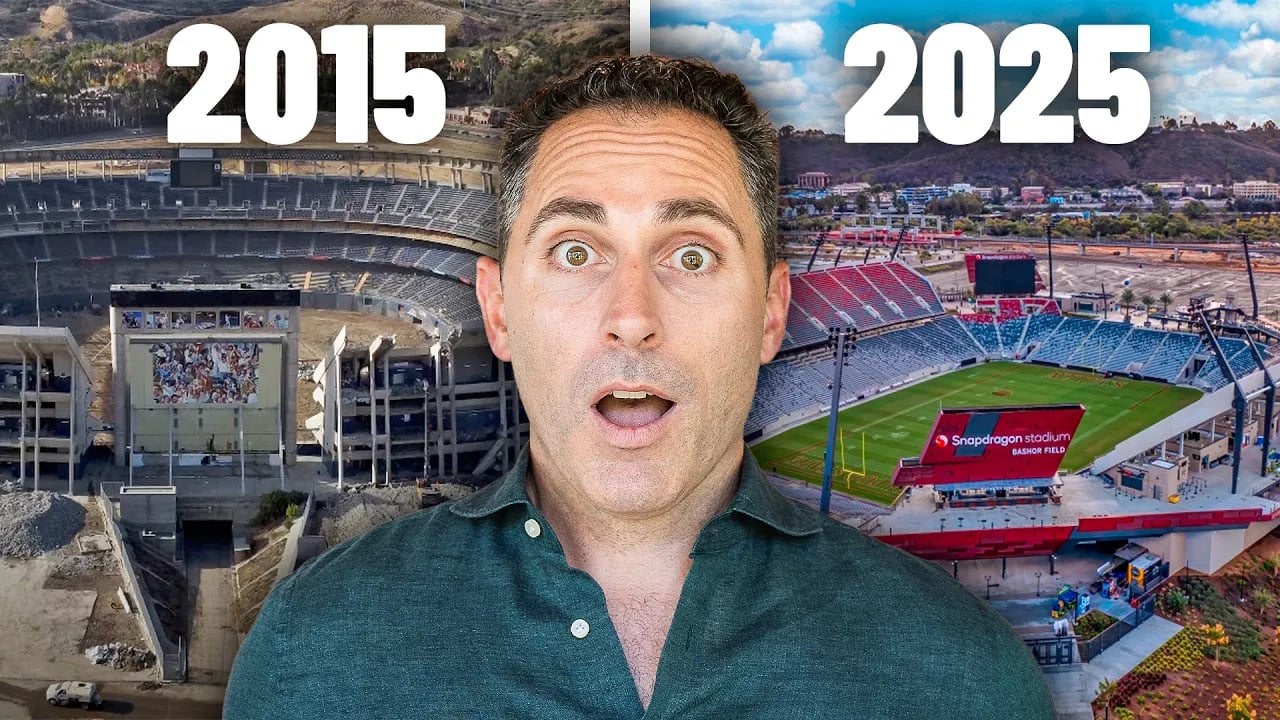
How Much Has San Diego Really Changed Over the Last 10 Years?
San Diego in 2025 doesn't look much like San Diego in 2015. Some of that change has been obvious — new construction, new transit lines, a different skyline. Some of it is more subtle, showing up in who's moving here, what things cost, and how the city actually functions day to day.
Here's a breakdown of the biggest changes I've seen over the last decade, so you can make smarter decisions about living, buying, or investing in America's Finest City.
Watch the full video: youtu.be/-M2_ZuJ-U-8
#1: Major Infrastructure Upgrades and Transit Improvements
A decade ago, San Diego's public transit system was an afterthought for most residents. That's changed meaningfully. Trolley line expansions — including the Mid-Coast extension connecting downtown all the way up to UTC and UC San Diego — have made large parts of the city genuinely accessible without a car for the first time. Add in ongoing airport improvements, road and freeway upgrades, and continued investment in bike infrastructure, and the city functions differently than it did in 2015. These upgrades haven't just improved daily commutes — they've reshaped which neighborhoods feel connected and convenient, which in turn has shifted where buyers want to live.
#2: Job Growth and Economic Resilience
San Diego's economy has diversified significantly over the last ten years. Biotech and life sciences have exploded, anchored by a growing cluster of research institutions and pharmaceutical companies. Tech has expanded well beyond its historical footprint, the military and defense sector remains a stable foundation, and tourism has continued to grow alongside it. That diversification matters — it means San Diego isn't as dependent on any single industry as it once was, which has made the local economy more resilient through the ups and downs of the last decade, including the pandemic disruption in the middle of it.
#3: Tourism, Culture, and Downtown Revitalization
Downtown San Diego has transformed. The Gaslamp Quarter, East Village, and the waterfront have all seen significant investment and redevelopment, and the city's cultural footprint has grown right along with it — more restaurants, more breweries, a more active arts and events scene, and continued growth around anchor events like Comic-Con. What used to feel like a downtown that emptied out after work hours now has a much more consistent daytime and nighttime energy to it.
#4: Housing Market Evolution
This is the change most people feel most directly. Home prices across San Diego have risen substantially over the last decade, and the market itself has changed in structure — new construction has increasingly shifted toward higher-density, mixed-use development rather than traditional single-family subdivisions, particularly as available land has become scarcer. Mortgage rates have also gone through a dramatic cycle, from historic lows earlier in the decade to a much higher-rate environment more recently, which has reshaped affordability and buyer behavior across the entire county.
#5: Growing Demand, Competition, and Lifestyle Appeal
San Diego's appeal hasn't faded — if anything, it's intensified. Remote and hybrid work gave people more flexibility to choose where they live, and a lot of them chose San Diego for the weather, the beaches, and the lifestyle. That's added a new layer of buyer competition on top of already-strong local demand, particularly from people relocating from more expensive markets like the Bay Area or from other states entirely.
#6: Cost of Living Reality Check
None of this growth has come free. San Diego's cost of living has climbed steadily over the last decade — not just housing, but everyday expenses like groceries, insurance, utilities, and childcare. For a lot of longtime residents, that shift has changed the calculus of staying versus relocating, and for newer residents, it's made the decision to move here a bigger financial commitment than it would have been ten years ago.
What This Means for Buyers, Sellers, and Investors
For buyers, the decade of change means today's market rewards preparation and strategy far more than it did in 2015 — competition, pricing, and rate volatility all require a more deliberate approach than "find a house you like and make an offer." For sellers, presentation and pricing matter more given how much more informed and price-sensitive today's buyers are. For investors, the areas benefiting most from infrastructure and economic diversification — particularly neighborhoods with new transit access — are worth watching closely, since those tend to be where the next decade's appreciation concentrates.
What the Next 10 Years Look Like in San Diego
If the last decade is any indication, expect continued infrastructure investment, continued economic diversification, and continued housing pressure driven by limited land and steady demand. San Diego isn't likely to become more affordable on its own — the constraints that have driven prices up (geography, zoning, coastal scarcity) aren't going anywhere. What will likely keep shifting is where growth concentrates, particularly around new transit corridors and areas seeing fresh development.
Whether you're thinking about buying, selling, or investing in San Diego, strategy matters more today than it did a decade ago. If you want help understanding where the real opportunities are right now, let's talk.
The Sean Zanganeh Real Estate Team Keller Williams Realty 12750 High Bluff Dr, Suite 300, San Diego, CA 92130
📞 (858) 345-9995 📧 [email protected] 💻 MySDDreamHome.com
Thinking about selling? Get your home's current value Looking to buy? Search Greater San Diego homes
Sean Zanganeh DRE #1851910 | DRE #01524589
#SanDiegoRealEstate #LivingInSanDiego #MovingToSanDiego #SanDiegoHousing #SanDiegoLife
