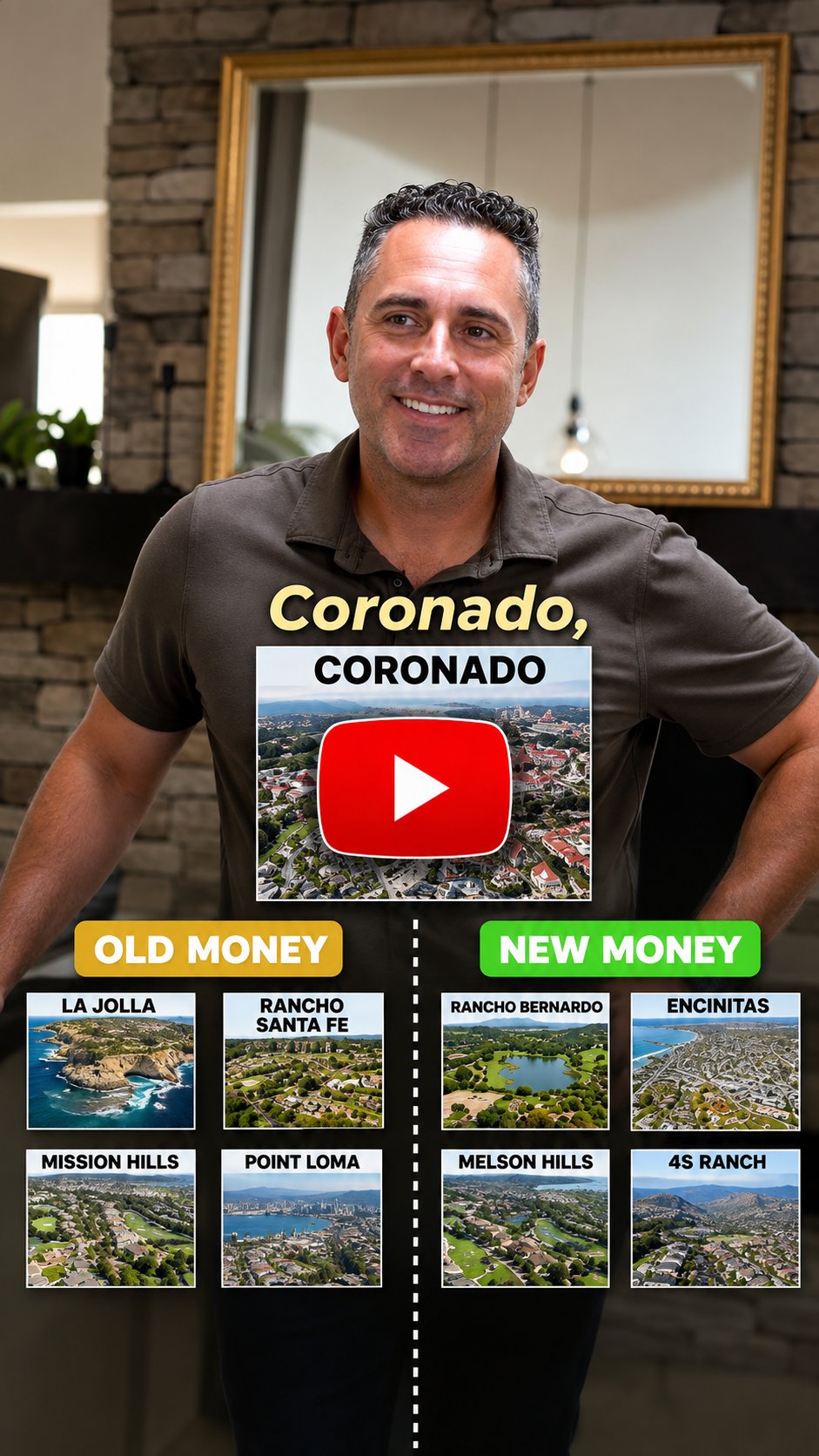
Old Money, New Money: The Story Behind San Diego's Luxury Neighborhoods
Not every luxury neighborhood got that way the same way. Some were built slowly, over generations, by families who never left. Others are being remade in real time by entrepreneurs, executives, and high earners who showed up in the last decade and started buying. Understanding which is which tells you a lot about what you're actually buying into — not just the house, but the community around it.
Watch the video: https://www.youtube.com/embed/WZLgb3EbFrQ
Old Money: Built to Last, Slow to Change
The Covenant, Rancho Santa Fe is San Diego's clearest old-money enclave. It's the original heart of Rancho Santa Fe, governed by its own association to protect architectural character, with estate lots and a tree canopy that took decades to mature. Turnover is slow, prices rarely dip, and the culture leans toward privacy over visibility. This is generational wealth — families who bought decades ago and have no reason to sell.
Muirlands and coastal La Jolla carry a similar weight. Muirlands has drawn prominent, established residents since the 1920s, and its winding hillside streets and architectural variety reflect nearly a century of accumulated history rather than a recent building boom. Coastal La Jolla more broadly has long been associated with academic, medical, and legacy wealth tied to UCSD and Scripps.
Coronado rounds out the old-money tier, with its Navy heritage, the historic Hotel del Coronado, and a small-town, low-turnover character that's remained remarkably consistent for generations.
New Money: Fast-Growing, Entrepreneur-Driven
Carmel Valley and the Del Mar Highlands corridor are where San Diego's newer wealth has concentrated. This is where biotech founders, tech executives, and high-earning professionals have been buying for the last 10-15 years — drawn by proximity to the biotech corridor, top-rated schools, and newer, larger homes built to modern standards rather than restored to historic ones. It doesn't carry generational weight yet, but it's where the money currently being made in San Diego is choosing to live.
Downtown San Diego's luxury condo market tells a similar story from a different angle — high-rise units drawing younger high earners, founders, and professionals who want walkability and skyline views over an estate lot, a very different value system than Rancho Santa Fe's, but no less serious about the price tag.
Solana Beach and parts of Encinitas are seeing a similar shift — long known for surf culture and a laid-back coastal identity, both are now pulling in new wealth that's driving prices up quickly, even as the neighborhoods themselves haven't fully caught up to their new price tags in terms of built-out luxury infrastructure.
The One Becoming Both: Del Mar
If there's a San Diego neighborhood straddling both categories right now, it's Del Mar. It has old-money bones — the historic Del Mar Racetrack, a small, tightly held downtown village, and coastal bluff estates that have changed hands within the same families for decades. At the same time, it's increasingly attracting a wave of newer wealth: entrepreneurs and executives drawn by top schools, coastal proximity, and a lifestyle that new money wants just as much as old money already has.
The result is a neighborhood in transition — new construction and renovated modern homes sitting next to decades-old coastal estates, and a buyer pool that spans both legacy families and first-generation wealth. Watching how Del Mar evolves over the next several years may say more about where San Diego's luxury market is headed than any single new development.
Why This Distinction Actually Matters
If you're buying at this level, knowing whether you're stepping into old money or new money isn't just trivia — it shapes what to expect:
- Old-money neighborhoods tend to have low inventory, slower price growth (because there's less to compare it to), and a community culture that values continuity over change.
- New-money neighborhoods tend to have faster price appreciation, more new construction, and a buyer pool that's actively reshaping the area's character in real time.
- Transitional neighborhoods like Del Mar can offer the best of both — established prestige with room for a newer buyer to make their own mark — but they also come with more variability in home style, pricing, and long-term direction.
The Bottom Line
San Diego's luxury market isn't one story — it's several running in parallel. Some neighborhoods are being preserved by the families who've always lived there. Others are being actively redefined by the next generation of high earners. And a few, like Del Mar, are becoming both at once. Knowing which story a neighborhood is telling can matter just as much as the price per square foot.
Trying to figure out which type of neighborhood fits what you're looking for? Reach out and let's talk through it.
